

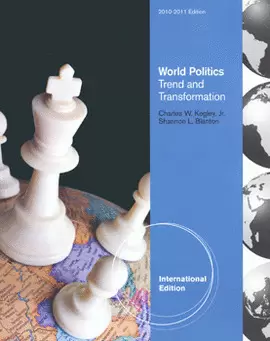
Understanding twenty-first-century world politics requires accurate and up-to-date information, intellectual analysis, and interpretation. In a globe undergoing constant and rapid change, it is imperative to accurately describe, explain, and predict the key events and issues unfolding in international affairs. These intellectual tasks must be performed well so that world citizens and policy makers can harness this knowledge and ground their decisions on the most pragmatic approaches to global problems available. Only informed interpretations of world conditions and trend trajectories and cogent explanations of why they exist and how they are unfolding can provide the tools necessary for understanding the world and making it better. By presenting the leading ideas and the latest information available, ´´World Politics: Trend and Transformation´´ provides the tools necessary for understanding world affairs in our present period of history, for anticipating probable developments, and for thinking critically about the potential long-term impact of those developments on countries and individuals across the globe. ´´World Politics: Trend and Transformation´´ aims to put both changes and continuities into perspective. It provides a picture of the evolving relations among all transnational actors, the historical developments that affect those actors, relationships, and the salient contemporary global trends that those interactions produce. The major theories scholars use to explain the dynamics underlying international relations-realism, liberalism, and constructivism, as well as feminist and radical interpretations-frame the investigation. That said, this book resists the temptation to oversimplify world politics with a superficial treatment that would mask complexities and distort realities. Moreover, the text refuses to substitute mere subjective opinion for information based on evidence and purposefully presents clashing and contending views so that students have a chance to critically evaluate the opposed positions and construct their own judgments about key issues. It fosters critical thinking by repeatedly asking students to assess the possibilities for the global future and its potential impact on their own lives.